Tuesday, September 30, 2025

Edward Coles view on slavery

Edward Coles: A Governor Who Freed His Slaves and Stood Against Injustice
Painting of Edward Coles, second governor of Illinois


Edward Coles is not a name most Americans immediately recognise, yet his life and convictions offer a striking example of moral courage in the face of entrenched injustice. Born into a Virginia planter family in 1786, Coles inherited slaves as a young man but resolved from early on that he could not, in good conscience, remain a slaveholder. In his own reflections as a student, he wrote that slavery and justice were “contradictory and mutually exclusive,” a belief recorded in his notes and preserved by historians a
Steel Snowflake.


A mural or historical depiction of Coles freeing
his slaves en route to Illinois


Coles’ stance was rooted in his conviction that the ideals of the American Revolution — liberty and equality — applied to all people, regardless of race. He considered the ownership of human beings not only a moral crime but also a betrayal of the nation’s founding principles. In 1814, he went so far as to write to Thomas Jefferson, urging the former president to use his influence to promote gradual emancipation in Virginia, an appeal documented in the Founders Archives. Jefferson’s reluctance to take action only deepened Coles’ resolve to live by his own principles. 

When the time came to leave Virginia, Coles put his words into action. In 1819, while traveling west to Illinois, he gathered the enslaved people he had inherited and declared them free, telling them they were now “as free as myself.” According to records preserved by Madison County GenWeb, Coles ensured the act was permanent by providing each family head with 160 acres of land and recording formal deeds of emancipation. This was not merely a gesture of charity but a deliberate attempt to guarantee their security and independence. 

For Coles, emancipation was not only a moral imperative but also a practical responsibility. He recognized that without resources, freedom would be precarious and uncertain. By giving land, he provided a foundation for farming, family stability, and economic independence. Scholars have noted in JSTOR that Coles saw slavery as corrosive not only to those enslaved but also to the character of slaveholders and the health of republican institutions, undermining democracy through corruption and division. 

The debate over slavery in early America:
Thomas Jefferson vs. Edward Coles


Coles’ conviction that emancipation should be gradual but inevitable set him apart. While radical abolitionists called for immediate change and defenders of slavery resisted all reform, Coles advocated for a steady transition that would, over time, erase the institution entirely. As highlighted in Steel Snowflake, he argued that the challenges of emancipation could never justify perpetuating injustice. True character, in his view, was measured by the willingness to act on principle, even at personal cost. 

Although Coles would later become the second governor of Illinois, his legacy is best remembered in his personal stand against slavery. By freeing those he inherited, equipping them with land, and speaking publicly against the spread of slavery, he embodied the values of liberty he believed essential to the republic. His life reminds us that freedom cannot be selective, and that justice demands both conviction and action.

Thursday, September 18, 2025

Eight Values of Free Expression

Why Promoting Innovation Is the Most Important Value of Free Speech

Coming from Iceland to live here in America for college, I often heard a phrase I barely heard before: “free speech.” Back home I rarely heard it, but here I hear it almost every day from classes, social media, and just people talking about it around me. In class we read a lot about reasons why free speech matters; it brings truth, self-government, tolerance, dissent, and much more. They are all really important; however, for me, it is that free speech promotes innovation.

Innovation as the Driver of Progress

A quote from the founder of Apple on innovation
I feel like free speech is not only about talking about what they want; it's also a place where you should be able to talk about new ideas. If a society does not have that, they will stay in the past. I believe this because when looking back at all inventions, art, and businesses that changed the world, they could not have happened without people willing to try a different route than the so called traditional way. A good example of how free speech promotes innovations is Steve Jobs with Apple. When he first introduced the iPhone, a lot of people thought it was unnecessary or just silly, but his willingness to push a bold idea forward completely transformed how we live today. Having free speech, you encourage people to share their ideas even though they seem crazy, and that's where real progress happens.

Why Innovation Matters More Than the Rest

Yes, it's true that free speech can lead to truth, hold governments accountable, and even teach tolerance. Despite these benefits, it doesn’t necessarily mean that much if society doesn’t move forward. “Innovation is the child of freedom and the parent of prosperity.” A society that innovates becomes stronger, smarter, and better at solving problems. If there is no place for creativity in a society, there will be a risk of losing progress but, most importantly, of not creating a good future for all. I just look at all the great scientific breakthroughs like vaccines or renewable energy and how without free speech these ideas might've been shut down. It doesn’t only affect the business economy but also social progress like civil rights movements and gender equality that have depended on pesple speaking their minds about new ideas about how the world could be different. I see innovation as not just making life more convenient but also driving justice, equity, and opportunity. That’s why I believe protecting space for new and fresh ideas is essential, as it ensures that a society keeps building and not just survives but rather thrives.

 Final Thoughts

Being a 17-year-old from Iceland now studying in the US, I look at innovation as the core of free speech. I look at free speech as more than just words; it's about creating a world where creativity, curiosity, and innovation can succeed. When people have the opportunity to share their ideas, challenge assumptions, and imagine something better, society becomes more interesting. It can also lead to solving problems of today and tomorrow. That’s why promoting innovation is, to me, the most important value of free speech.

Tuesday, September 16, 2025

The Bible and Slavery: Arguments For and Against Biblical Support
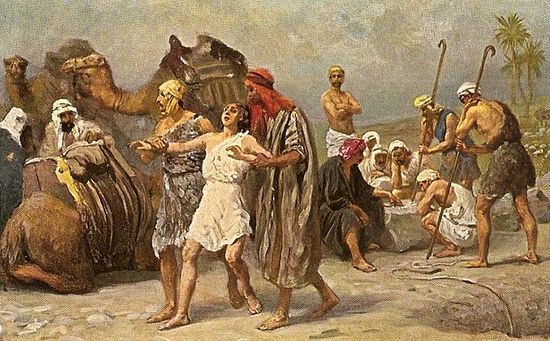
Slavery around the time of the Bible
Introduction 
    The relationship between biblical texts and slavery has been one of the most contentious debates in Christian history. During the antebellum period in America, both pro-slavery and abolitionist Christians used the same biblical texts to support opposing viewpoints. This analysis examines how the Bible has been interpreted both to support and condemn slavery. 

Biblical Arguments Supporting Slavery 
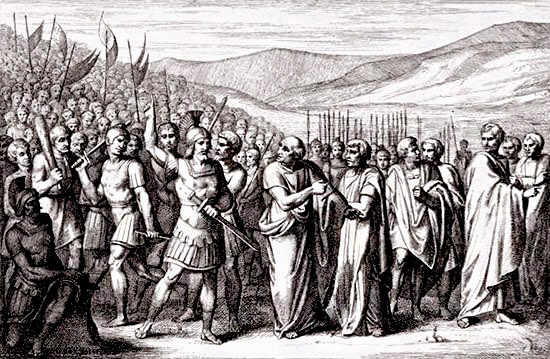
Slavery during the Roman Empire
    The Old Testament regulated rather than prohibited slavery. Leviticus 25:44-46 allowed Israelites to purchase slaves from surrounding nations and pass them as property to their children. Exodus 21:2-11 established rules for Hebrew debt-slavery with different treatment for male and female slaves. In the New Testament, slavery was widespread in the Roman Empire, and early Christian writings addressed it as an existing social reality. Pro-slavery Christians pointed to passages where Paul instructed slaves to obey their masters (Ephesians 6:5, Colossians 3:22) and returned the runaway slave Onesimus to his master Philemon. American slaveholders frequently cited the "Curse of Ham" from Genesis 9, claiming God created black people to be slaves through Noah's curse on his son Ham.

  Biblical Arguments Against Slavery 
    Christian abolitionists argued that Genesis 1:27, stating humans are made "in the image of God," provided the theological foundation for human equality and dignity that made slavery incompatible with Christian faith. They emphasised that all people possess equal value and worth as God's creation. The Bible prohibits kidnapping (Exodus 21:16, 1 Timothy 1:8-10). Abolitionists argued that since the transatlantic slave trade was based on kidnapping Africans, it violated clear biblical prohibitions against "man-stealing." Early Christian opposition existed as well—Gregory of Nyssa preached against slave ownership in 380 AD, demonstrating some early Christians saw slavery as morally problematic. 

Historical Context in America 
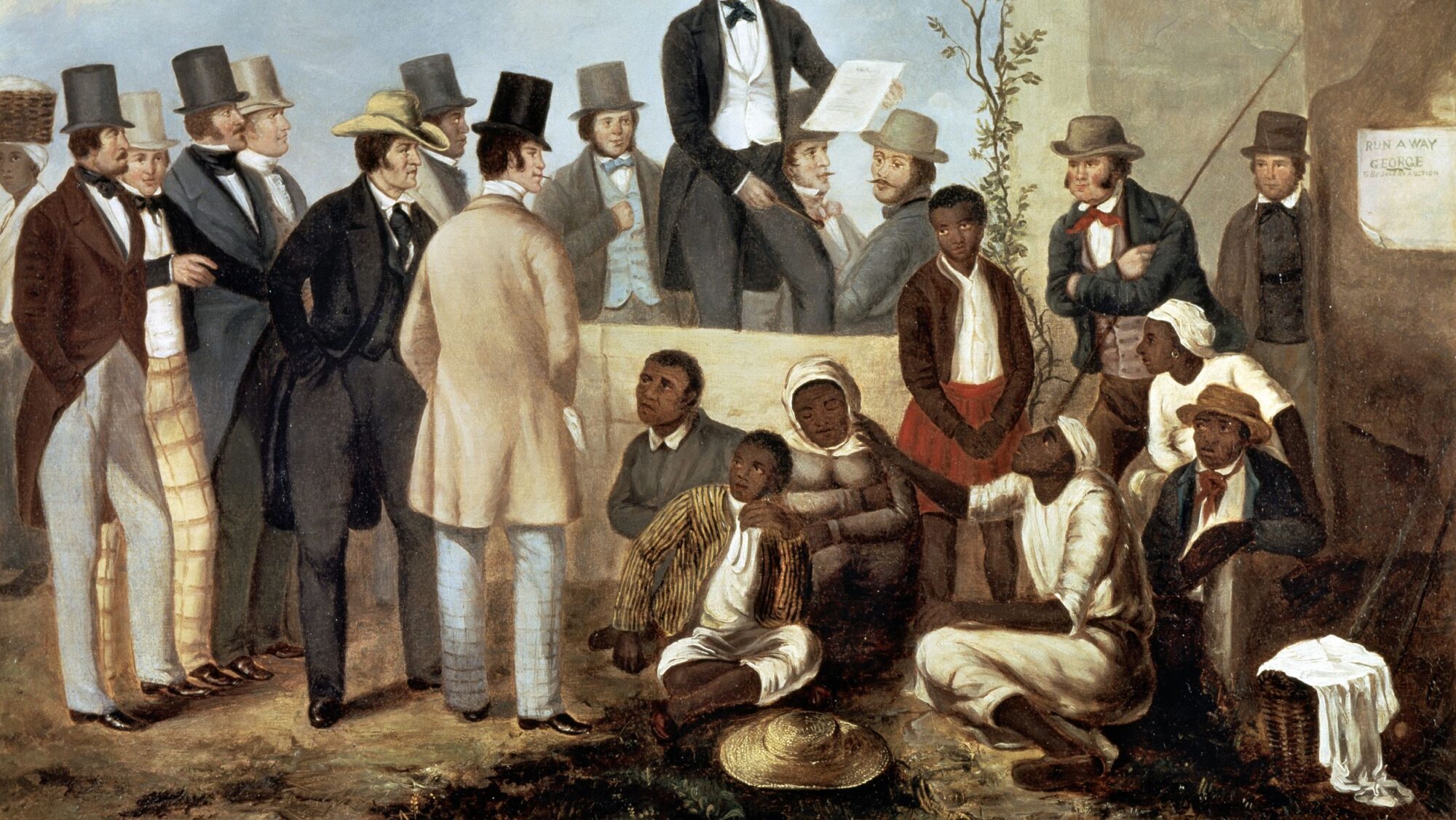
Slavery in America
I learned that pro-slavery Christians dominated the debate initially, using biblical texts to justify the institution. However, I found that abolitionists, though initially in the minority, gained support among Methodist, Baptist, Adventist, and Presbyterian denominations. Many members freed their slaves and sponsored black congregations where ministers encouraged slaves to believe freedom was achievable.
  
Conclusion
Through my analysis, I found that the biblical debate over slavery reveals the complexity of scriptural interpretation and cultural influence on biblical understanding. While the Bible contains passages regulating slavery as an existing institution, I discovered it also contains principles of human dignity, justice, and love that many Christians came to see as incompatible with slavery. I concluded that the fact that committed Christians on both sides could find biblical support demonstrates how cultural assumptions shape interpretation. Ultimately, I observed that the abolitionist interpretation gained dominance not necessarily because their arguments were more textually obvious, but because they emphasised broader biblical themes of liberation, justice, and human equality. This historical debate serves as a reminder of the importance of careful interpretation and awareness of how social context influences biblical understanding.

Thursday, September 4, 2025

Supreme Court Reflection


The Supreme Court of the United States is the most
powerful court in the world

When I first learned about the U.S. Supreme Court, I was struck by how much power is concentrated in the hands of just nine people. It’s often called the most powerful judicial body in the world, yet I think its influence is surprisingly quiet. Unlike a president or Congress, the Court doesn’t win support through speeches or campaigns. Instead, I feel its authority comes from something less visible: the public’s belief that its decisions are legitimate.

Alþingi, one of the oldest Parlament
in the world
    As someone from Iceland, this feels both familiar and foreign. Iceland’s parliament, the Alþingi, founded in 930 AD, is one of the oldest in the world, so I understand the weight of history in shaping a nation’s identity. But while the Alþingi feels closer to the people, I think the U.S. Supreme Court feels more distant. Its job is to interpret a constitution written more than 200 years ago, and I often wonder what it means to apply words from that time to modern problems. I feel there’s something both impressive and unsettling about relying on such an old document to govern a society that looks nothing like the one that wrote it.

    The Court’s history with slavery shows me just how powerful its decisions can be. In the Dred Scott v. Sandford case of 1857, the Court ruled that African Americans could not be citizens. When I read about this, I felt shocked that such a decision was ever possible—and it made me realize how the Court’s interpretations can deny or grant rights to entire groups of people. I think this case is a reminder that the Supreme Court is not just interpreting laws, but actively shaping the course of a nation.

The nine current Supreme Justices
(2025)
    I also feel uneasy about how little influence the public has in choosing the justices. Over 100 people have served on the Court, and each has had the power to draw the boundaries of government authority. I think their independence is important—it protects them from short-term politics—but it also makes me wonder whether decisions that affect millions should be left in the hands of people the public never directly chose.

    In the end, I feel this contrast highlights how differently countries approach democracy and trust. In Iceland, politics feels smaller and more accessible. In the U.S., I think people put incredible faith in a very small group of justices to safeguard their most important values. Seeing this from the outside makes me reflect on a bigger question: how much power should any society give to so few individuals—and what does it mean when that power rests mostly on trust?

EOTO reflection

 Today I witnessed in my classroom a mock trial of Brown v. Board of Education , the historic 1954 Supreme Court case that reshaped public ...